
Performance#
GeoUtils benchmarks its operations to ensure efficiency and robustness to updates.
The benchmarks tests measure execution time and memory usage, check lazy and out-of-core behaviour with Dask and Multiprocessing, track improvements or regressions over time, and compare different execution modes and calculation engines, including external checks against GDAL CLI and PDAL.
The benchmarks use GeoUtils’ profiling tool described in Profiling.
Improvements or regressions over time#
The GeoUtils benchmark webpage summarizes performance of core functionalities and their changes with commit history. It relies on Airspeed Velocity (ASV) to record reproducible performance measurements for each commit and publish them.
Comparison across execution modes, engines and external CLI tools#
GeoUtils compares eager, Dask and Multiprocessing execution using the same deterministic inputs. Reprojection, clipping, polygonization, rasterization and gridding additionally use equivalent GDAL CLI commands with matching output grids, data types and storage options where possible. Every result identifies its operation, numerical method, calculation engine, chunk strategy and execution mode separately. Engine comparisons use eager execution, while execution-mode and chunk-strategy comparisons fix the other dimensions. Fixed-size Numba checks additionally exercise each compiled gridding kernel in Dask and Multiprocessing workers. The Rasterio/GDAL calculation engine used inside GeoUtils remains distinct from the external GDAL CLI reference. Raster subsampling and raster-to-point conversion use equivalent PDAL CLI pipelines as an additional external reference.
Four reference graphics summarize the core results:
End-to-end time relative to GDAL for each comparable operation
Additional RAM by operation after subtracting each initialized process-tree baseline
Additional RAM as raster size increases
End-to-end time relative to PDAL for raster subsampling and point cloud conversion
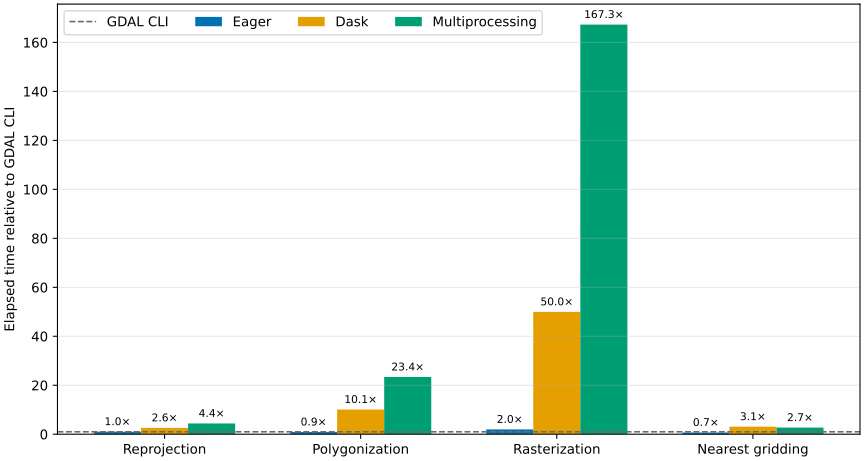
Execution time on the largest raster size shared by every execution mode and the GDAL CLI. GDAL is the reference.#

Additional RAM on the largest shared raster. Each bar is the process-tree peak minus the initialized baseline measured immediately before the operation.#

Additional RAM for the benchmark process and all execution-mode workers as raster dimensions increase.#

End-to-end time on the largest workload shared by GeoUtils and PDAL. PDAL is the reference at one. Dask completes an in-memory dataframe, while Multiprocessing and PDAL complete file-backed GeoPackage output.#
These graphics show the latest complete CI benchmark and may be newer than this documentation version. Download the exact values and run metadata.
Test suite for scalable execution and large datasets#
Every GeoUtils operation listed as chunked or lazy is tested on all supported Python versions and operating systems to ensure its respect of Dask laziness, deferred I/O, and loading behaviour, while yielding exactly the same output as in-memory operations, within numerical tolerances.
In addition, GeoUtils also includes large data tests running on latest Python and Ubuntu releases, verifying that these operations use less memory than loading the full raster would require, while yielding a correct result.